First Checks · Range Repair
Viking Range Burner Clicks But Will Not Light
A single Viking burner that sparks endlessly without catching is almost never a failed spark module. How to tell a wet electrode from a blocked port from a real gas fault, before anyone quotes you for parts.
Signed
Hollis Yamada
- Role
- Service technician — refrigeration and cooking
- In the trade
- 21 years in the trade
- Holds
- EPA 608 certified
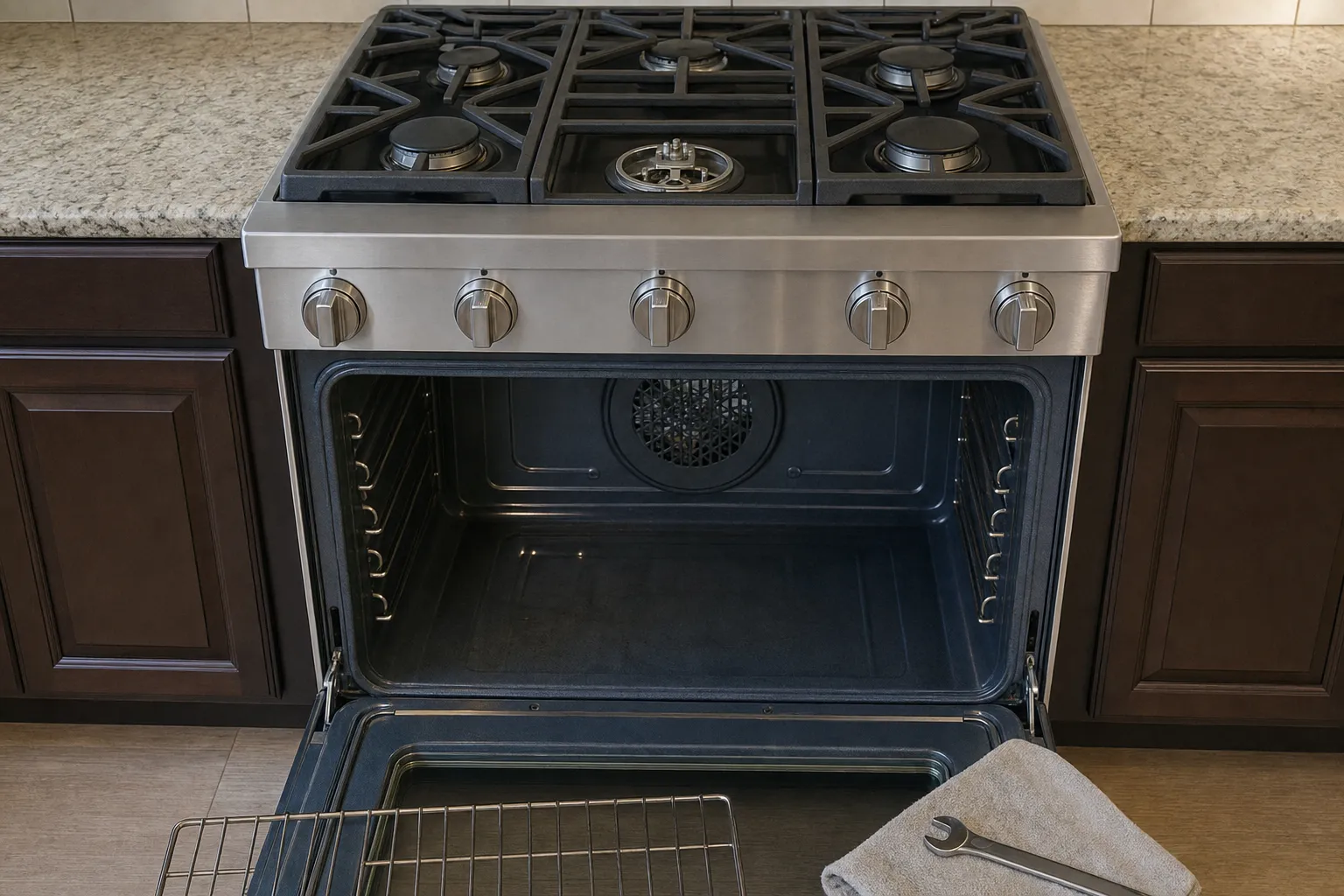
Few faults on a Viking range are quoted wrong as often as this one, and few come up as regularly on Mercer Island: a burner that sparks over and over and never takes. Read the click as good news. It says the spark module is alive, the switch is closed, and power is reaching the electrode. What is absent is either fuel at the port ring, or a spark strong enough to cross to it.
Nearly every quote we see for a “failed ignition system” on a single burner is wrong. A spark module serves the whole cooktop. If it had failed, no burner would click at all. When one burner misbehaves and the rest are fine, the problem is almost always local to that burner — and local problems are cheap.
What the clicking is actually telling you
One movement of the knob does two jobs. The valve for that burner opens, and a switch behind the panel signals the spark module, which answers by firing every electrode across the cooktop at once — that is why the whole range ticks when you only asked for one burner. Only the burner with gas flowing has anything to ignite.
So the clicking confirms three things are working: the switch inside the knob, the module, and the wiring to that electrode. Whatever is wrong sits downstream of all of it.
There are only four realistic candidates:
- a saturated or fouled electrode that cannot produce a hot enough spark
- blocked ports on the burner head, so no gas reaches the spark gap
- a misaligned burner cap, sitting proud or rotated off its seat
- a gas delivery fault at that valve or orifice
The first three account for the overwhelming majority. The fourth is rare and is the only one that genuinely needs a technician with a manometer.
Start with the cap, because it is free
Lift the cast grate off and look at the burner head. On a Viking sealed burner the cap must sit dead flat in its recess, with the small locating notch engaged. If it has been washed and dropped back on in a hurry — which happens constantly after a big dinner — it can sit a millimetre high or rotated a few degrees. That is enough to move the port ring away from the spark gap.
Lift the cap, wipe the seat, set it back down and rock it gently with a fingertip. It should not move. If it does, it is not seated, and you may have just fixed your range for nothing.
While the cap is off, look at the ring of ports around the head. Boil-over residue bakes into those holes and closes them, particularly on the burner nearest the sink or the one everyone uses for pasta. Ports blocked next to the electrode mean no gas arrives where the spark is, no matter how healthy the spark is. A straight pin or a paperclip clears them — never a drill bit or anything that can widen the hole, because port size is what sets flame shape.
Then look hard at the electrode
The electrode is the small white ceramic post standing beside the burner head with a metal tip. Two things stop it working.
It is wet. Anything spilt on the cooktop wicks into the ceramic, and a damp electrode leaks its charge sideways instead of jumping the gap. Clicking continues, but the spark is weak and blue-white rather than a sharp snap. Twenty-four hours of air drying, or a few minutes with the oven on and the cooktop dry, resolves it. This is the single most common cause of the symptom, and it is why the fault so often appears the morning after a large meal.
It is fouled. Carbon and grease build a conductive film on the ceramic that does the same thing permanently. A dry brush over the post — brass, not steel wool — usually restores it.
Look at the gap too. The tip should sit a few millimetres from the burner head, consistently with the other burners. If it has been knocked while cleaning and now touches the head or sits far away, the spark has nowhere useful to go. Bending it back is a technician’s job, because ceramic snaps and a broken electrode turns a free fix into a parts order.
When it is genuinely a gas problem
If the cap is seated, the ports are clear, the electrode is dry and clean, and the burner still will not light, the question becomes whether gas is arriving at all.
Two tests separate this quickly. First, hold a lit match or lighter to the burner head with the knob at low — carefully, and only if you cannot smell gas already pooling. If it lights and burns cleanly, gas delivery is fine and the fault is electrical. If it will not light even with a flame right on it, gas is not reaching the ring.
Second, compare flame behaviour on the other burners. If every burner burns tall, yellow and lazy rather than as a tight blue cone, the issue is upstream — supply pressure, a regulator, or a range that was converted between natural gas and propane without the orifices being changed. We see the conversion problem regularly on Mercer Island, usually on ranges that moved house with their owners.
A blocked or wrong-sized orifice on one burner produces exactly this symptom on that burner alone. It is a small brass part, it is inexpensive, and swapping it takes minutes — but identifying it requires knowing what the flame should look like at a measured pressure, which is where a service call earns its money.
What this costs and when to call
If the fix is a seated cap, cleared ports or a dried electrode, it costs nothing and takes ten minutes. Try that first — genuinely, we would rather you did.
Call when any of the following is true: you can smell gas at any point, more than one burner shows the same fault, the clicking continues after a burner has lit, the electrode is cracked or bent, or nothing lights even with a flame held to the head. Those are the cases where measurement beats guesswork, and where continuing to experiment is the expensive option.
What should never happen is a cooktop replacement quote for a single burner that will not light. If you have been given one, the diagnostic behind it was not done.
Before you ask
Is it safe to keep using the range while one burner clicks?
For a short period, yes, provided you can smell no gas and the burner is switched off between attempts. Continuous sparking with the valve open pushes unburnt gas into the room, so turn that burner off and use the others until it is looked at.
Why do all the burners click when I only turn on one?
That is normal on most Viking cooktops. A single spark module fires every electrode at once, and the burner with gas flowing lights first. It only indicates a fault when the clicking continues after a burner has lit.
Can I clean the spark electrode myself?
Carefully, yes. With the burner off and the cap and head lifted away, a dry toothbrush or a soft brass brush over the ceramic tip removes most of the residue. Do not use water, and do not bend the electrode — the gap to the burner head is set at the factory.