Island Houses · Range Repair
Cottage or Ranch: The Pre-Install Electrical Check That Changes by Block on Mercer Island
Two Mercer Island houses a few streets apart can need different pre-install work for one Viking range. Check the circuit, gas run, floor and panel.
Signed
Hollis Yamada
- Role
- Service technician — refrigeration and cooking
- In the trade
- 21 years in the trade
- Holds
- EPA 608 certified
Decide first
Call or wait
-
If you smell gas at the range — Touch no knobs or switches. Get everyone out and call the gas utility or 911 from outside. Call today
-
If a flame turns yellow or drops out only while the oven and other burners run — Stop using that burner, write down what else was on, and book. The supply side is checked before any part. Book this week
-
If a breaker trips partway through a long bake — Leave it off until the visit and note what else was running when it went. Do not keep resetting it. Book this week
-
If nothing is wrong yet and a new range is on order for an older house — Confirm the circuit, the gas run, the floor and the panel before delivery day. Safe to wait
Call today: ring Viking Appliance Repair Mercer Island at (206) 208-3377. Book this week: use the booking page. Safe to wait: not urgent, book when it suits you.
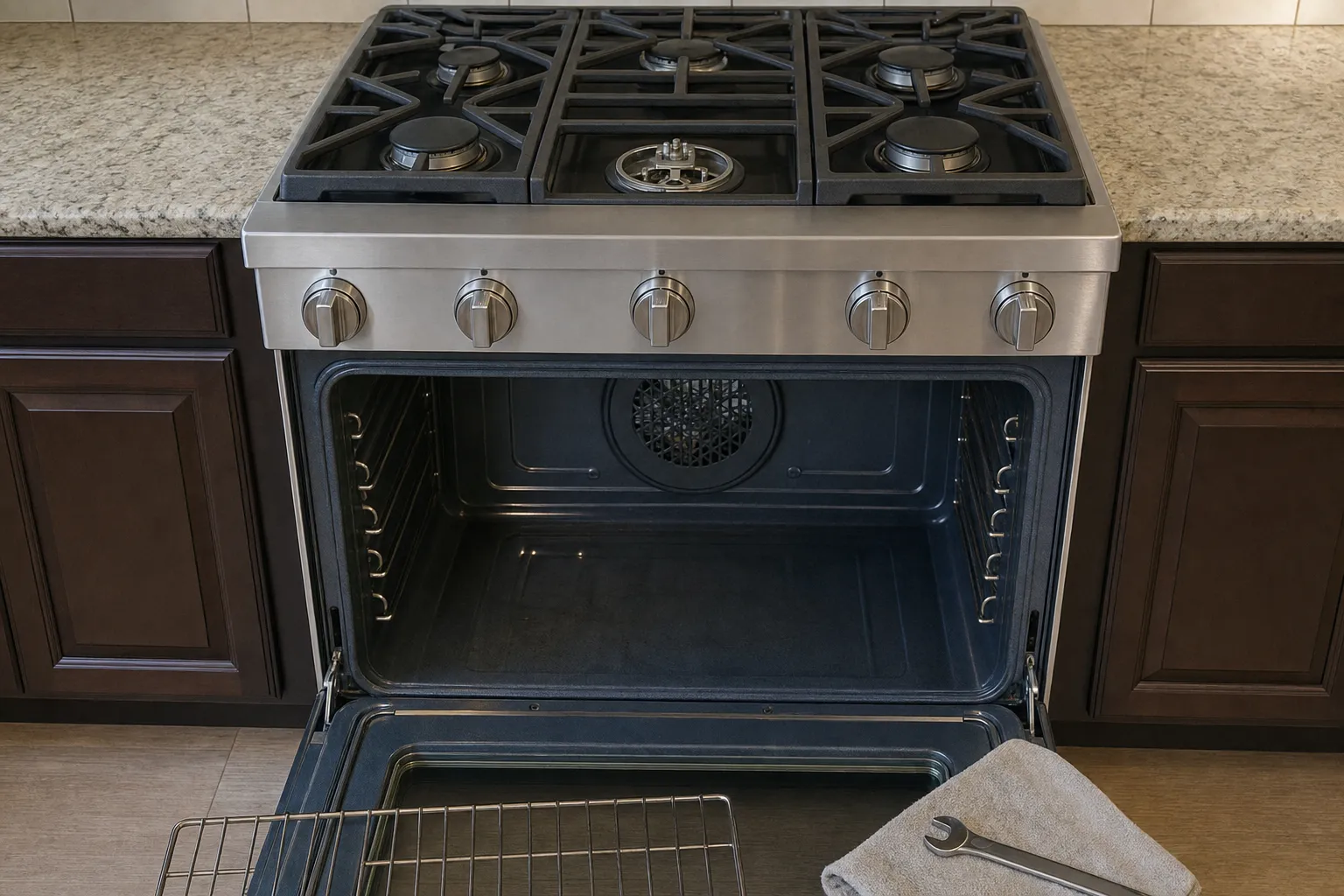
Two houses four streets apart on this island can want completely different things from an electrician before a professional range is delivered, and the reason is chronology. The Mercer Island Historical Society records that the first floating bridge across the lake opened on 2 July 1940 and that ferry service ran until it did; East Seattle, next to the old ferry landing, was the first part of the island settled, and it still holds vintage houses, some of them over a century old.
That is as far as the local history goes for our purposes, and it is enough. A house built when the island was reached by boat was wired and piped for a different century of cooking than a house built after the road arrived. Everything below follows from that one fact, not from the neighbourhood name on the listing.
The part of the year that matters
November and December. Not because of weather, but because that is when a kitchen gets asked to do everything simultaneously — full oven, several burners at output, the griddle down, a second appliance on the same leg — and simultaneity is what finds an undersized supply.
For eleven months a marginal circuit or a thin gas run looks perfectly healthy, because nothing is ever fully loaded. Then a family of fourteen arrives and the house is running at a level it has never been asked for. The call comes on a Thursday afternoon in late November, and the fault it reports has usually been present since installation day.
What the swing asks of the machine
A dual-fuel professional range is two appliances sharing one chassis. The gas half wants enough delivered volume that every burner can run at full output at once without the manifold pressure sagging. The electric half wants a dedicated 240V branch circuit of its own, sized to what the rating plate asks for and run properly, not shared and not extended.
Both halves are polite about being underfed until they are not. Gas starvation shows up only when total demand is high, which is why a burner that behaves alone misbehaves when the oven fires. An undersized or long electric run shows up as voltage drop under load, which the oven experiences as an element that cannot hold temperature and the control experiences as a supply doing something it did not expect.
A converted East Seattle or First Hill house was never drawn for either. The service is often original in capacity terms, the gas piping was sized for a small mid-century load, and the floor framing under the kitchen was not laid with the weight of a professional range in mind. The mid-century ranch stock at Mercerwood and the family houses through Emerald Hills usually have the room and the floor, and the questions there move to the age of the panel, what the branch wiring is made of, and how short the vent run is.
The failure it produces, and when
The gas side fails as flame quality. A tall yellow flame instead of a tight blue cone. Burners that drop out of simmer the moment the oven ignites or the hood goes to high. A grill or griddle section that heats at one end and stays cool at the other because the section is not getting the volume its manifold assumes.
The electric side fails as heat that will not arrive. An oven that sits under its set point no matter how long it is given, a breaker that lets go partway through a long roast, or a control panel that resets itself when something else on the circuit starts.
Both look like appliance faults. Both are frequently supply faults wearing an appliance costume, and the giveaway in either case is that the symptom is load-dependent — it appears when other things are running and disappears when they are not.
Getting ahead of it
Before a range is ordered, five things are worth confirming, and all five are checkable.
What circuit exists behind the appliance opening, at what rating, and is it dedicated. What the total gas load of the new appliance is against what the existing run and meter can deliver at the far end of the house. Whether the floor under the opening can carry the weight without the unit rocking once it is levelled. What the venting path actually is, in real elbows and real feet. And what the panel has left in it, which on the older stock is the answer that most often stops the project.
For an appliance already installed and misbehaving, the homeowner’s part is simpler: note when it happens in normal use (which burners, oven on or off, what else was running) and write it down. Do not try to recreate it. A yellow, lazy flame means stop using that burner; a breaker that trips stays off until the visit. That written note is worth more than any description of the symptom on its own.
What we do on the visit
We reproduce the load first and measure second. Voltage at the appliance under full electric demand rather than at rest, flame behaviour with the oven called and every burner lit, the igniter and spark module tested at the module rather than judged by the sound of the clicking, then the burner ports, caps and orifices, and only then the valves and the control.
That order matters because it separates the appliance from the house. If the flame is clean at low total demand and lazy at high, the answer is on the supply side and no part will fix it. If it is lazy at every demand, the fault is at the burner.
A visit is $89, deducted from the repair when you go ahead with it. Printed bands for igniter and burner work, oven elements and control boards sit on the range and oven repair pages. Where the answer is the gas run or the panel, we will say so plainly, and that part belongs to a gas fitter or an electrician, not to us.
Have the model number from the tag ready when you call (206) 208-3377; it is the first thing we will ask for.
Before you ask
Why does a burner drop out of simmer when the oven comes on?
That is the signature of gas supply rather than a failed valve. As total demand rises, pressure at the manifold sags, and the lowest-flow setting is always the first casualty. If the same burner holds a simmer perfectly with everything else switched off, look at the pipe run, its length and the meter before buying any part.
What electrical work does a professional range need in an older island house?
A dual-fuel unit wants a dedicated 240V branch circuit sized to what its rating plate asks for, run properly rather than shared or extended from something else. In houses that predate the 1940 bridge, the service capacity is usually the real constraint rather than the kitchen wiring, so the panel is the first thing worth pricing before anything is ordered.
The oven runs cold whatever I set it to. Is that the thermostat?
Possibly, but supply and sensor get verified before anything is replaced. We measure voltage at the appliance under full load, compare sensor resistance against what the control expects, and log real cavity temperature across an entire preheat. Where the thermostat or the element genuinely is the fault, the price band for that work is printed on the oven repair page.