First Checks · Oven Repair
Viking Oven Set to 350 But Baking at 300
An oven that runs cold has three usual causes and they are easy to tell apart: a drifted temperature sensor, a weak bake element or igniter, and a door that no longer seals. What to check before ordering a control board.
Signed
Hollis Yamada
- Role
- Service technician — refrigeration and cooking
- In the trade
- 21 years in the trade
- Holds
- EPA 608 certified
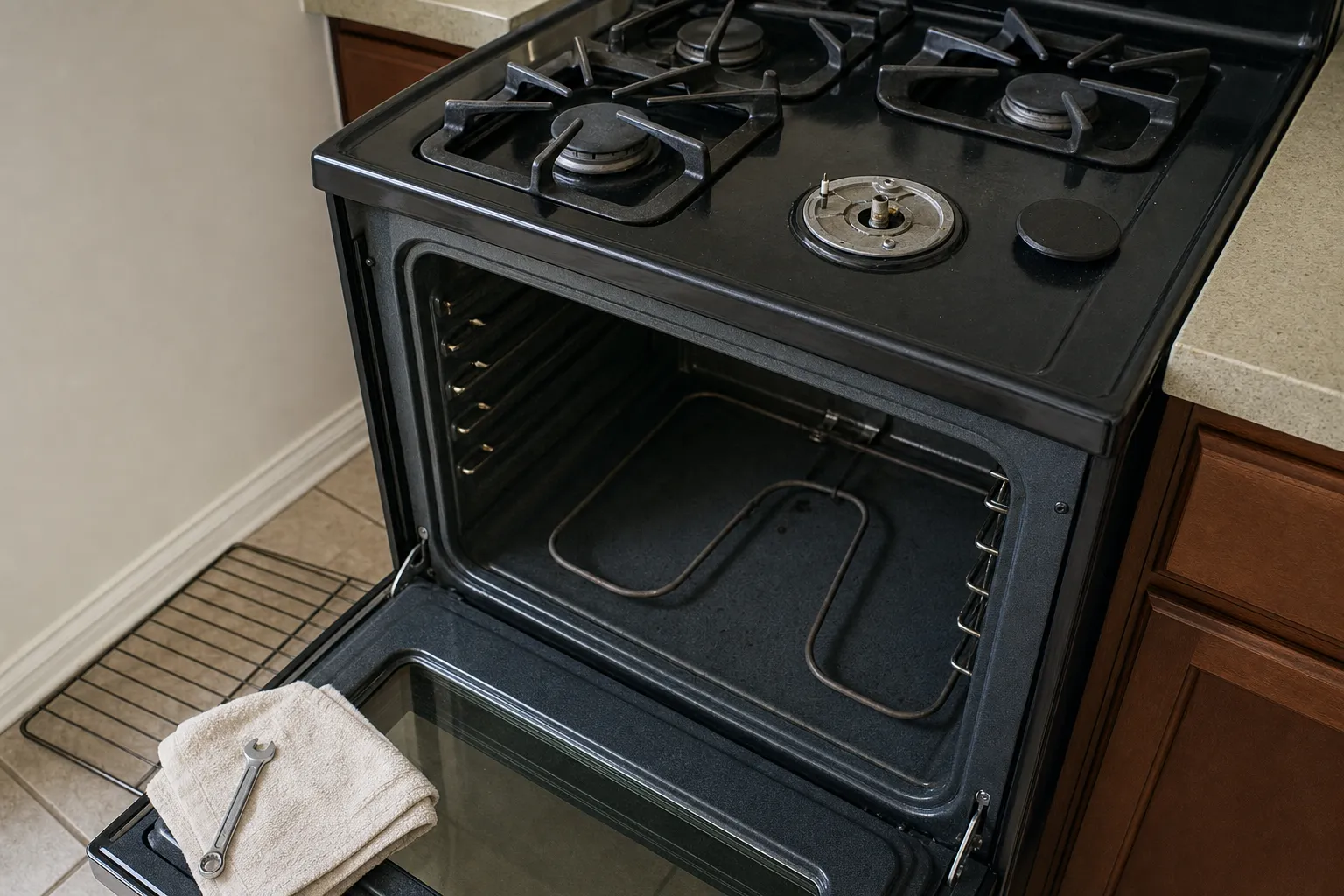
An oven that will not reach the temperature on the dial is a quieter fault than a burner that will not light, and it tends to be lived with for months. People compensate — an extra ten minutes here, a higher setting there — until a recipe that has always worked comes out pale and flat and the penny drops.
On a Viking wall oven or range oven, a consistent shortfall of 40 to 60°F is not mysterious. There are three realistic causes, they produce distinguishable symptoms, and only one of them is expensive. A control board, which is what these calls often get quoted as, is the rarest of the four possibilities.
Measure it properly before anything else
Almost every wrong diagnosis in this category starts with a bad measurement.
Put an oven-safe probe thermometer on the centre rack — not hanging from a rack bar, not sitting on the floor of the cavity, and not resting against the wall. Set the oven to 350°F and leave it alone for a full twenty-five minutes after the preheat chime. That wait matters, because ovens overshoot on the first climb and then settle. Reading at the chime tells you nothing.
Then take three readings five minutes apart and write them down. What you are looking for is not a single number but a pattern:
- Steady and low — say 300, 302, 299 — points at calibration or the sensor.
- Swinging widely — 290, 350, 300 — points at heat production or the door.
- Climbing then collapsing — reaches 340, drops to 280, recovers — points at an element or igniter that is failing under load.
Those three patterns map almost cleanly onto the three causes below, which is why the fifteen minutes spent measuring saves an hour of chasing.
A drifted temperature sensor
The oven sensor is a resistance probe, usually a short metal rod protruding into the upper rear of the cavity. Its resistance changes predictably with temperature, and the control reads that resistance to decide when to call for heat. Over years of thermal cycling — and especially after repeated self-clean cycles — the relationship drifts.
A drifted sensor produces the steady and low pattern. The oven is not struggling to make heat; it is stopping too early because it believes it is already there. Everything runs consistently cool, at roughly the same offset, on every setting.
This is a genuinely cheap repair. The sensor is an inexpensive part, it is held by two screws, and its plug is immediately behind the rear panel. It is worth confirming with a resistance measurement at a known temperature rather than swapping on suspicion, but as failures go this is the good outcome.
A weak bake element or a lazy igniter
Electric and gas ovens fail differently here, and it is worth knowing which you have.
On an electric oven, the bake element should glow evenly orange along its full length within a couple of minutes. Look for a section that stays dark, or a blistered, pitted or sagging spot. A partially failed element still produces heat — just not enough — so the oven climbs slowly, undershoots and cycles constantly. That is the swinging or collapsing pattern. Check the broil element too: some recipes and some preheat routines lean on it, and a dead broil element makes preheat times balloon.
On a gas oven the equivalent part is the igniter, and its failure mode catches people out. A weak igniter still glows bright orange, which looks perfectly healthy. What opens the safety gas valve, though, is the current the igniter pulls, and on an ageing one that has fallen away even as the glow stays bright. The valve then takes its time. The result is a long delay before gas flows, sometimes minutes, and a cavity that never gets ahead of its own heat loss. Timing it is the giveaway: from cold, an igniter that takes more than about ninety seconds to bring on gas is on its way out, however bright it looks. A glowing igniter is not a working igniter, and that single fact explains most misdiagnosis on gas ovens.
A door that no longer seals
The third cause has nothing to do with heat production at all. If the oven is making the right amount of heat and losing it, the result on the thermometer looks identical.
Run your hand around the closed door during a bake cycle. Warmth at the top edge or a corner means the gasket has gone hard, torn or pulled out of its clip. Look along the top of the door for a gap when it is shut — a sag of even a quarter inch means the hinges have lost tension, which happens after years of things being set on an open door.
Two quick tests: close the door on a sheet of paper and pull. It should drag noticeably all the way round, and equally at both sides. Then, with the oven cold, open the door halfway and let go. A healthy door holds its position; a door that drops shut or falls open has tired hinge springs. Gaskets and hinges are both serviceable parts, and both are far cheaper than the control board that gets blamed for their symptoms.
When it is worth a call
Do the measurement and the door check yourself — between them they identify the cause more often than not, and both are free.
Call when the reading is more than 40°F out and stable, when an element shows a dark section or damage, when a gas igniter is slow from cold, when the door sags or the gasket is split, or when the oven has started throwing an error code alongside the temperature problem. Those all point at specific, identifiable parts.
What is worth resisting is a control board quote issued without a sensor resistance check, an element inspection and a door test. On a Viking oven running consistently cold, the board is rarely the answer — and it is by a wide margin the most expensive place to guess.
Before you ask
How many degrees off before a cold oven is worth fixing?
Around 25°F either way is within normal cycling for most ovens and bakers rarely notice it. Beyond 40°F you will see it in pastry and roasting times, and that is worth diagnosing rather than compensating for.
Is the calibration offset in the settings a fix?
Only after the cause is known. Calibration offset is designed to trim a small, stable error. Using it to mask a failing sensor or a weak element hides a fault that will keep drifting, and you end up recalibrating every few months.
Does a self-clean cycle damage anything?
It can. The cycle runs the cavity far above cooking temperature, which is hard on door gaskets, hinge springs and the thermal fuse. If an oven starts running cold shortly after a self-clean, that sequence is not a coincidence.